
TV Reminders, Memory, Superstition, FamilySearch Citations, Wild Animals, Borders, When They Spoke, and the Johns
And our Genealogy AI Webinar

Our most recent social media posts.
Historical TV Show Reminders
I’m off-again, on-again watching the latest iteration of “All Creatures Great and Small.”
My English forebears had long left England by the time period covered by the book. However, a significant amount of the plot, at least so far, concentrates on the TB testing of cattle and the resistance of many farmers to it.
I then remember my great-grandfather who in the US during this same time period refused to let his herd be tested to the point where he was arrested. He posted bail and allowed the testing to take place.
I may have to go down this rabbit hole later. There’s always something to learn.
But I know to use television, particularly any historical fiction, as a memory jogger and research prompt and not as fact.
What’s the last thing television reminded you of that related to your genealogy research?
Memory Reliance
It’s easy to see how stories told by a family member are reliant upon the accuracy of their memory. After all, the family member is telling you those stories. But most of what is contained in other records comes from someone memory as well. The person’s memory of what they were told may be accurate (or it may not). What they were told originally may have been accurate or it may have not.
Information on census records, marriage applications, birth and death certificates, and a variety of other documents comes from someone’s memory. No “proof” was necessary and the clerk or census taker simply wrote the information down and went on.
It’s not just Grandma’s memory of personal stories that a genealogist relies upon. It’s the memories of many people that were used to create the records we use.
Some Memories
Grandma Didn’t Realize It
[some memories--do you write down yours?]
Memories are often made when we don’t realize it. Sometimes later we realize those are the best memories of all.
It was towards the end of my senior year of high school when my Dad discovered that I had a day off in school in the middle of May–senior skip day it was called. It was a day of final exams and seniors didn’t have to take them and didn’t have to attend school either.
Therefore, according to my Dad, it was the perfect day to clean out the west side of the barn. It was also the same day as the senior party at some location that I have either forgotten or never knew in the first place. If Dad decided it was the day to clean out the barn, then it was the day to clean out the barn. And so that is what we did.
Grandma Neill was right there in the thick of things. It was several years before a series of strokes caused Grandma to become less mobile and, at seventy-five, she had no difficulty helping. So on that warm spring day, Grandma (in her house dress and knee high rubber boots), my Dad, and I cleaned out the west side of the barn. After all, the “bnure,” which is how “manure” always sounded when Grandma said it needed to be dealt with. Dad used the “H” with a small loader on it to scoop up some of the mess, but pitchforks were main instrument of getting the manure in the manure spreader. When the “bnure” spreader was full, Dad would go out and spread it while Grandma and I remained in the barn and filled up the small loader on the front end of the H and scraped some manure from the cement wall that formed the west ends of the barn.
So off Dad went.
My Dad had a handful of phrases he would use that we all had heard many times. Cliches that spoke of eternal truths one would learn first hand when they were an adult, “wait til you start paying the bills,” “life ain’t a bed of roses,” and “you don’t realize it” were three favorites.
Exactly how it started after Dad had left has been lost to time, but Grandma must have said something and I quipped back “Grandma you don’t realize it, life ain’t a bed of roses.” She laughed. She knew I was kidding and that I’d never tell her something like that in any serious way.
And so Grandma replied “Wait til you start paying bills.”
We were working. We weren’t loafing. The scoop on the front of the H got filled with bnure, and we did the other scraping that we were supposed to do. But along the way,
“Grandma…wait til you start paying the bills.”
The irony was lost on me then. It’s not lost on me now. I was telling a seventy-five year old woman that she didn’t know what life was like. This was a woman who had lived away from home since she was twenty-five, had (along with her husband) grown up pretty poor, and had worked on the farm “like a man” (as some used to say). Grandma knew what life was like.
She laughed and replied “Life ain’t a bed of roses.”
I laughed and told Grandma “you don’t realize it.”
We were both laughing as we shoveled cow shit. Work was sometimes difficult enough. One could have a little fun while doing it. We kept teasing each other with Dad’s retorts until we heard it.
The tractor was returning. We stopped laughing. I don’t think either one of had to tell the other that the time for hilarity was temporarily over. There wasn’t really supposed to be laughing while one was supposed to be working and we didn’t want to have to explain to Dad what was so darn funny.
Dad returned. We filled up the spreader and Dad went to spread it. As soon as he was out of earshot, we started again. I don’t remember who was the instigator and I’m certain it really doesn’t matter. Our laughter subsided when we heard the tractor return.
I don’t know if my classmates have memories of that senior party. I certainly don’t. But I do remember helping Dad and Grandma clean out the west side of the barn.
And I do have one of the fondest memories of Grandma as a result. It just took me a long time to realize it.
Superstitions
Today’s Friday the 13th (well it was when I wrote this). Another day for some of us...perhaps most of us.
But have you written down superstitions various family members had?
My great-grandmother said you always had to leave the house through the same door you entered.
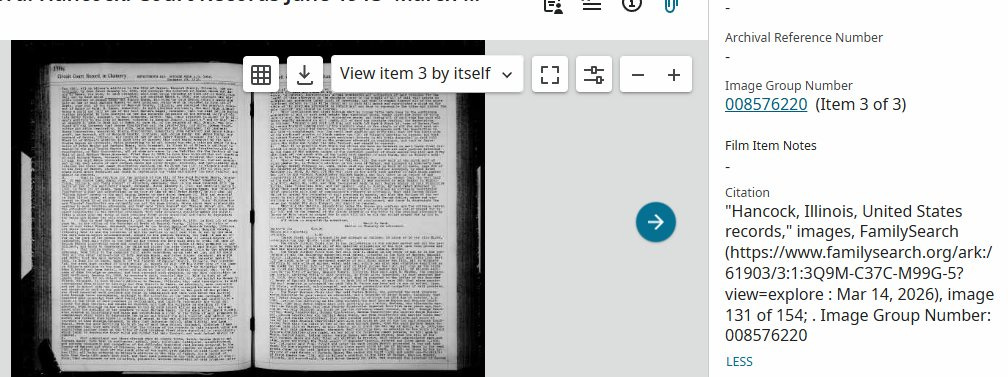
That FamilySearch Citation
A little bit of opinion here. When using images from FamilySearch, the citation they have really only tells you where you got it on their site.
It’s incomplete, especially for copies of actual records.
You should also determine what it is you are looking at. What office created the record? What file was it is? What book/page was it from?
These details matter to me because they help me know what I’m looking at and can help me to analyze it. I need more detail than just a county record I found on FamilySearch.
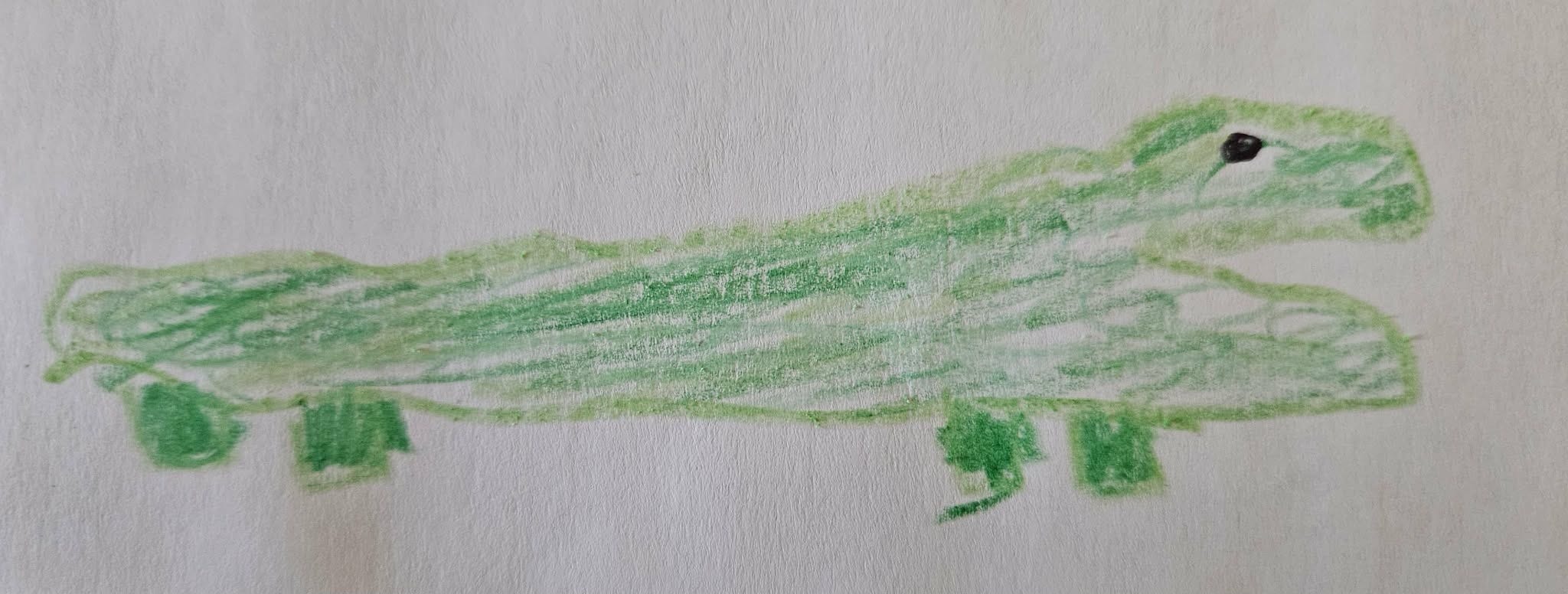
Wild Animals?
Do you know what wild animals there were in your ancestor’s neighborhood that they had to protect themselves, their garden, or (if they had them) livestock from?
This is not an AI created illustration.
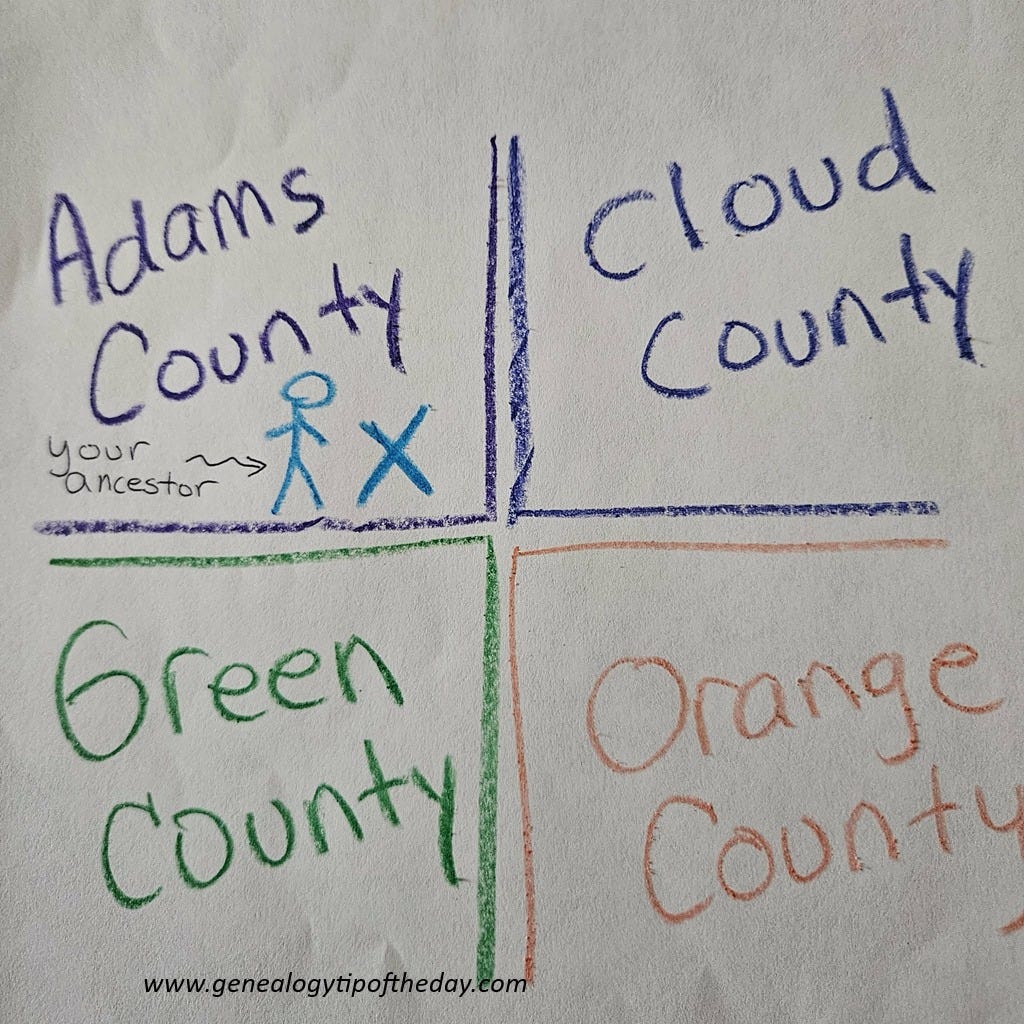
Borders
Browsing adjacent pages in census, tax, and other records organized geographically is great, but remember that there may be very near neighbors to your ancestor living in other counties as well.
As shown in this high-tech illustration.
And if your ancestor lived in the middle of the county, he may have lived near a township line so near neighbors may be in adjacent townships as well as the township in which your ancestor lived.
And if the ancestor lived near the state line...
Borders matter...
Changing the Will of the Dead
When my 3rd great-grandmother died in Quincy, Illinois, in the 1920s, she was survived by all but two of her children. Her pre-deceased son had one child. Her pre-deceased daughter had three children. Those four grandchildren were left $25 each in their grandmother’s will. The surviving children received larger portions. The estate was not huge, but my 3rd great-grandmother was reasonably well-off for the time period.
They protested.
The will was not thrown out, but the surviving children decided to amend the amount given to the grandchildren. The son of the son got $600 and the children of the daughter got $200 each (there were three of them).
The agreement to change the amount to the grandchildren was approved.
Have you seen an estate where a portion of the will was thrown out or altered?
Keep in mind that this can’t be done willy-nilly. In this case, ALL the surviving children agreed and the probate judge approved the change.
It can happen.
When they Still Spoke
Have you ever looked at a family picture and thought that must have been taken before the argument, the divorce, etc.?
Sometimes it can be a way to approximately date a photograph—if you know when the estrangement started. Just make certain the estrangement stuck. Sometimes people have a permanent estrangement, other times it’s temporary, and in some cases, it’s an on-again, off-again sort of thing.
Ran across an old undated picture of my grandfather and his brother-in-law and I thought that had to have been taken before 1969 when great-grandpa died because that was when my grandmother stopped talking to that sister and the husbands did also by default.
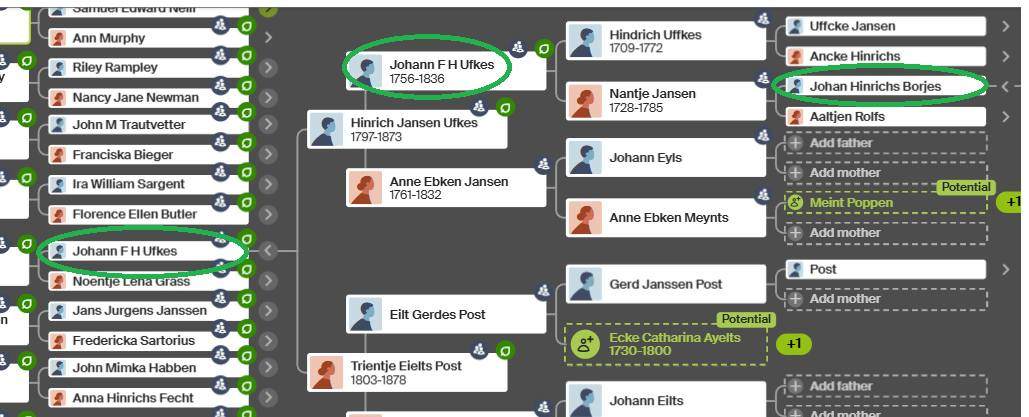
Generations of Johns
The name John (Johan(n)) has been passed from grandfather to grandson since Johan Hinrichs Borges (my 6th gr-grandfather). I’ve circled my gg-grandfather on the far left and the earlier generations.
I’m the only one for whom it has been John since birth (my grandfather was actually Johann as well).
How many documented generations do you have for a name to be passed down? John is my middle name because my grandmother on the other side of the family could not stand her brother John and was NOT going to have a grandson with it as a first name.
It’s not a competition...just a little challenge.
And in my case, the John ended with me. And that’s just fine.
Introduction to Artificial Intelligence for Genealogy
Been curious about using artificial intelligence for your genealogy research? In this hour-long session, we will provide an overview of responsible and simple ways to use artificial intelligence to assist with your genealogy research. Our focus will be practical, easy-to-follow techniques to use artificial intelligence to jumpstart your research in a responsible manner. We won’t talk about ways to create images or fiction but will show you how to incorporate AI into your research in down-to-earth ways that don’t waste your time. We will see how to use AI to get research ideas, focus your research, transcribe handwriting, organize and extract information—and how to create your own research prompts.
AI can be used as a research assistant that’s always available. See how to take advantage of it without the hype.
Presentation is available on 18 April. Pre-order price is $22—order yours today. Price after 18 April is $30.
Until Next Time,
Michael
Genealogy Tip of the Day
www.genealogytipoftheday.com
On the flip side, in my family, I look for the first Ester.
I have a lot of cousins of various generations named Esther, and I know the one born in 1918 was named for my great-grandmother, Phoebe Esther. I know this because my mother's name was supposed to be Esther, until her first cousin was born before her and got the name. This was important to me as a kid because I was named for my mother, so my name might have been Esther!
Then I found my great-grandmother, Phoebe Esther born 1868, was named for her two grandmothers, Pheby and Ester. My 3xggrandmother Ester was born in 1790. I was more excited to find that she was named for her grandmother Esther, born around 1725 in Yorkshire. A baby born in the New World was named for her grandmother left behind in the old country by her homesick dad.
So the first Ester, born 300 years ago, is my 5xggrandmother. Surely she isn't the first one, tho.
How far back does the name Ester go? There's a fun puzzle to solve.